
Your vote matters
Vote NO on Question 2
Protect our schools. Elect representatives who will stop downshifting taxes.

HB 1300 took this decision out of local hands.
HB 1300 forces this state-written question onto our ballot instead of preserving local control over when and how we decide our school district’s budget. Our representatives Rita Mattson, Jim Qualey, and John Hunt voted in favor of it.
The Real Story
Why Question 2, and HB 1300, are misleading
The cap is presented as tax relief. In reality, it ignores why local school taxes keep rising: the state keeps paying less.

Six years of one-party control
Republicans have controlled all three branches of state government for six years. They have withheld public-school funding while expanding private-school vouchers, repeatedly cutting business taxes, and refusing federal grants. New Hampshire now ranks last in the nation in the share of state funds it commits to education.

The burden lands here
Republican leaders blame schools for spending too much when the real problem is that the state spends too little. If the measure passes, local districts may be forced to cut staff, programs, or services even though the ballot text promises classroom instruction and school-based services will not be affected.
Follow the Money
Why your property taxes are so high
It is not because school boards are on a spending spree. The state has steadily shifted its responsibility onto local property taxpayers.
35% → <26%
of state share of public-school costs since 2007
54% → >63%
rise in local property-tax share over the same period
>83%
special education costs paid by local property taxpayers
Question 2 limits local levy growth to inflation and new construction, but it does not account for the state cutting its share again. The Hold Harmless program that once cushioned towns from lost aid is being phased out, and 145 towns already received less state money this year.
If state aid keeps shrinking while the local levy is capped, districts will have to cut staff, programs, or services because they cannot raise the local match without another three-fifths vote. No one can honestly predict which school programs will be affected.
The Cap Versus Reality
The cap cannot keep pace with the costs our schools must pay
The cap is tied to an inflation measure of about 3.9%. But the unavoidable costs of operating a school district are rising many times faster.
+31%
projected increase in the average cost of heating oil
17.4%+
average health-insurance rate increase for public risk pools such as SchoolCare
69–70%
increase in diesel-fuel costs over the past year
~$500K
surprise SchoolCare assessment Jaffrey-Rindge had to absorb last year
These are necessities, not extras
School buses run on diesel. Buildings need heat. Districts must provide health insurance to recruit and retain teachers and staff. These costs cannot simply be wished away when they rise faster than the cap.
Students will feel the difference
When operating costs far outpace the allowed increase, schools cannot meet the cap without cuts. Those cuts will reach staffing, programs, transportation, maintenance, or other services that directly affect students, despite the ballot’s promise otherwise.
Last year, Jaffrey-Rindge was also hit by the financial fallout from SchoolCare’s historic $30 million statewide mid-year deficit assessment, forcing the district to absorb an unexpected bill of approximately $500,000. A rigid cap leaves little room for emergencies like this.
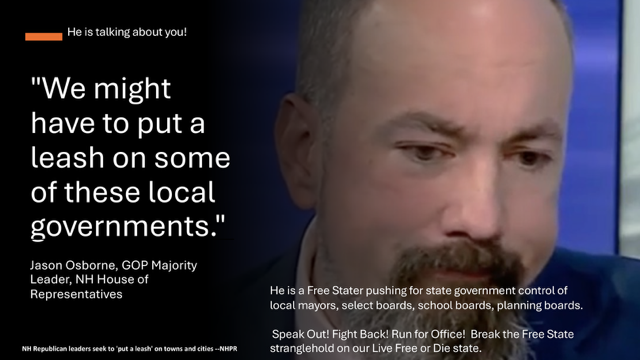
Their goal is state control
“Perhaps, if they are unwilling to cap themselves, the state will step in and cap local taxes for them.”
— Jason Osborne, a Free State-aligned Republican with his eyes on becoming Speaker of the House.
His words make the intent clear: if local voters and school districts do not impose these cuts themselves, state leaders are prepared to do it for them. All the while, refusing to fund schools appropriately from the state level.
Know Before You Vote
This is not the usual local tax-cap process
The cap is presented as tax relief. In reality, it ignores why local school taxes keep rising: the state keeps paying less.

Locked in for two years
Unlike the existing town-meeting process, this measure appears to provide no easy off-ramp if the cap is not working. Overturning would require 3/5 majority and would have to wait until a town’s slated deliberative session. Meanwhile, cuts required to meet the law would likely be irreversible.

Written by the state
It bypasses the existing local process and puts the question on every ballot whether your town asked for it or not. Last year 9/11 towns rejected tax caps on their warrants, including Jaffrey-Rindge.

Not politically neutral
One of the bill’s own sponsors said part of its purpose was to drive general-election turnout. This is not the simple, apolitical tax question it is presented as.

Representatives who voted for HB 1300
Rita Mattson (Rindge, Jaffrey, Dublin)
Jim Qualey (Rindge, Jaffrey, Dublin)
John Hunt (Rindge)
Read it Yourself
Ballot measure text based on HB 1300
“Shall the [name of municipality] limit property tax growth for [name(s) of school district(s)] under RSA 32:5-i. If adopted for a two-year period: (1) the local property tax levy may not grow beyond the prior year’s amount, adjusted for inflation and new construction; (2) SAU central office spending may not exceed 6 percent of total school district appropriations; and (3) bonded capital costs are excluded from both limits. These caps apply only to administrative operations of the SAU central office and do not affect classroom instruction, school-based services, or other municipal expenditures. These limits may be overridden as provided in RSA 32:5-i. Adoption requires a three-fifths (3/5) majority vote.”
Vote NO on Question 2
Protect public schools, preserve local control, and elect representatives who will stop downshifting state costs onto local taxpayers.